

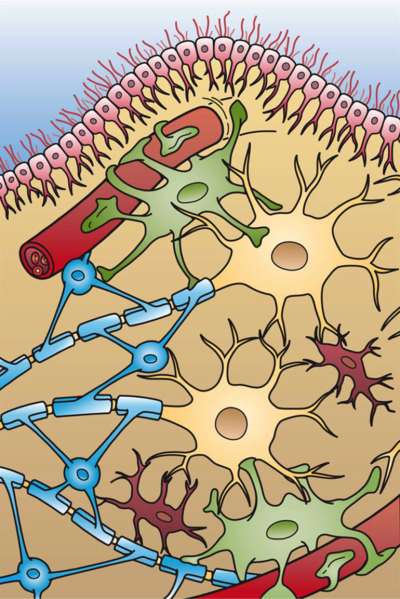
Glia, also called glial cells or neuroglia, are non-neuronal cells in the central nervous system (brain and spinal cord) and the peripheral nervous system that do not produce electrical impulses. They maintain homeostasis, form myelin, and provide support and protection for neurons. In the central nervous system, glial cells include oligodendrocytes, astrocytes, ependymal cells, and microglia, and in the peripheral nervous system glial cells include Schwann cells and satellite cells. They have four main functions:
(1) to surround neurons and hold them in place;
(2) to supply nutrients and oxygen to neurons;
(3) to insulate one neuron from another;
(4) to destroy pathogens and remove dead neurons.
They also play a role in neurotransmission and synaptic connections, and in physiological processes like breathing. While glia were thought to outnumber neurons by a ratio of 10:1, recent studies using newer methods and reappraisal of historical quantitative evidence suggests an overall ratio of less than 1:1, with substantial variation between different brain tissues. Glial cells have far more cellular diversity and functions than neurons, and glial cells can respond to and manipulate neurotransmission in many ways. Additionally, they can affect both the preservation and consolidation of memories.